When it comes to the conversation of empire, the story is mostly told with two sides in mind: the oppressor and the oppressed. In the story of physical conquest specifically, these sides refer to the conqueror and the conquered respectively. What’s often looked over, though, is the middle ground— a person or group with characteristics of both sides. The person in this position is in a complicated state; they are neither on one side nor the other. They may identify more with one group, yet they don’t fully belong to a single category. They are a cultural hybrid. Today we shall explore these complex cultural mixtures in the context of 16th century and 20th century Peru and how they relate, followed by an analysis of the implications of this relationship. To do so, we will look to the Andean kurakakuna and compare them to Peruvian photographer Martín Chambí.
Prior to the 1500s, modern day Peru was ruled by the Inca Empire, the conqueror of the Andeans. The empire was a grand civilization, one that displayed its culture through various elements such as the Inca tunic, or uncu, special cumbi cloth, and the mascapaycha headdress for the Sapa Inca (king Inca). In the early 16th century, however, the Spanish Empire made its way across the Atlantic with the intentions of exploiting the plentiful resources of the Inca land through colonization. And so they did; by the mid-1500s, the former Inca Empire was under the control of the Spanish, while the Inca commoners were sent to work in the dangerous silver mines of Potosí to extract resources for Spain. The question then remains: what happened to the Andeans? The majority of Andeans were commoners as well, and therefore joined the Inca in their manual labor (mita). However, the few elite Andean that remained were granted the status of kurakakuna— nobility. The Spanish allowed them to preside over the commoners and be exempted from mita. These kurakakuna were entangled in quite the situation; although they had indigenous blood, they reaped the same benefits as the 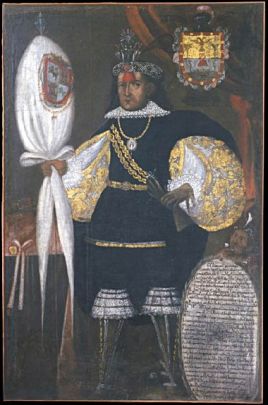 Spanish did. They even began to act like the Spaniards, adopting parts of their culture and encouraging their colonial behavior. The kurakakuna were given swords and horses resembling those of the oppressors of the Inca, along with the right to create European heralds representing their lineage. The most critical fact about their position, though, was that they fed into the colonial system by delivering laborers to the mines and therefore supporting Spanish-driven oppression. Regardless, they still wore the mascapaycha and uncu with pride, but not without an addition of Spanish culture, as they dyed their uncus the signature European purple and added European lions. Although they “Spanishified” native culture, they “nativized” Spanish culture as well, adding the famous Inca amaru (snake), the symbol of Inca revival, to their uncus. The role of these kurakakuna was thus very confusing; did they support the Spanish— as they sent their own Inca and Andean commoners off to the mines— or did they oppose them, plastering the amaru onto their clothing suggesting a future rebellion? It seems as though they were on both sides of the situations, and yet neither, giving themselves the mark of a true cultural hybrid.
 Although the Inca never completely had their revival as the amaru suggested, this intricate cultural mixture did. In the 20th century, photographer Martín Chambí was in a position that I argue is very similar to that of the 16th century kurakakuna. To understand how, one must look to Michael Hill’s article on mystical tourism in Peru. Many tourists often come to Machu Picchu in search of an “adventurous” or “exotic” experience, fueling an institution known as “mystical tourism”. Whites/mestizos/tourists are intent on experiencing native culture in a matter of a few days, causing the tourist industry to pick and choose parts of native culture that can quickly and easily be taught to tourists. As a result, the native is “disembodied”. Some of the natives, on account of their impoverished state, are swept into this system and economically manipulated to commodify their culture for tourist purchasing. Thus, we once again find that the native culture is being controlled for the benefit of an oppressor, with the subtle oppressor in this case being tourist culture. So where does Martín Chambí tie into this oppressive tourist-native
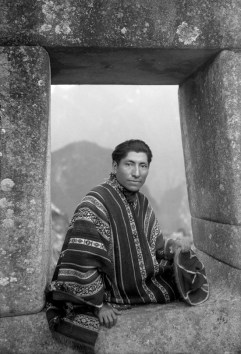
  relationship? Chambí was a proud Andean famous for photographing pictures of Machu Picchu and depicting Inca power through his work. He spoke the native language of Quechua and was an active member of the native power indigenismo movement. However, Chambí was also an active supporter of the Peruvian tourist industry, as Hill underscores in his Andean self-fashioning article:
Indeed, Chambi advocated tourism as he made clear in an interview in 1958: “Since I began taking photography seriously, I only had one goal: to tell the world about the natural beauty of my country and the beautiful image of the ruins that speak of our historic past, with the aim of promoting wherever possible, and according to my means, tourism in Peru”.
— James Scorer, “Andean Self-Fashioning: Martín Chambi, Photography and the Ruins at Machu Picchu”
As noble as his intentions were, Chambí supported the same industry known for the disembodiment and economic manipulation of the Inca. His work fueled the oppressive mystical tourist industry. Because Chambí has ancestral ties to the native culture and yet also plays a prominent role in tourist culture, it appears as though he lies in the ill-defined, confusing middle of these two groups just as the kurakakuna did. Regardless of their intentions, though, both the kurakakuna and Chambí were native advocates that also fed into the industry of the oppressor, whether that oppressor was bold like the Spanish Empire or inconspicuous like the mystical tourism industry.
Considering the fact that both the kurakakuna and Chambí have found themselves in this “middle ground”, we can reasonably conclude that cultural hybridity is a timeless phenomenon. Not only that, but the existence of these two groups in itself rejects the black and white oversimplifications of such historic political issues. It seems that colonial and economic problems involving “sides” are much more complicated than we, the public, had previously anticipated.
Don Marcos Chiquathopa, ca. 1740-45. Museo Inka, Cuzco, Peru.
Scorer, James. “Andean Self-Fashioning: Martín Chambi, Photography and the Ruins at Machu Picchu.” History of Photography, vol. 38, no. 4, 2014, pp. 379–397., doi:10.1080/03087298.2014.942490.
Hill, Michael. “Inca of the Blood, Inca of the Soul: Embodiment, Emotion, and Racialization in the Peruvian Mystical Tourist Industry.” Journal of the American Academy of Religion, vol. 76, no. 2, 2008, pp. 251–279. JSTOR, http://www.jstor.org/stable/25484002.


Hi Aliza, this blog post on the cultural hybridity in Peru is very insightful. I particularly like the tie between the history of Andeans and how that plays into how indigenous culture is perceived by tourists and other Europeans. I also liked how you pointed out the duplicity of Martin Chambis’ work, while it could be argued that he was invested on bringing the Andeans back to their roots and putting a face on the commoners, he also contributed to the imperialistic and oppressive machine by not only celebrating but undermining the true potential of the original Peruvian people.
LikeLiked by 1 person