“America rules the world— by force.”
— Harry Browne, American writer
For those of us in humanities core, this past quarter has conditioned many to immediately associate quotes like this with related historical situations ranging from Spanish atrocities in the Andes to British conquest in India. Today’s blog post centers around the idea that the American superpower reflects many traits associated with another key character of our curriculum, Aimé Césaire’s protagonist in A Tempest: the commanding and dominating Prospero.
Prospero is the self-proclaimed ruler of the island in A Tempest. Césaire describes the magician/technology enthusiast as power hungry, obsessed with conquest and colonization. Prospero credits himself for “saving” the other creatures on the island, such as Ariel and Caliban, despite the fact that some of those creatures ruled the island prior to his arrival. Yet, the colonizer feels as if he is destined to create order from the apparent disorder prevalent on the island— even though nobody asked him to.
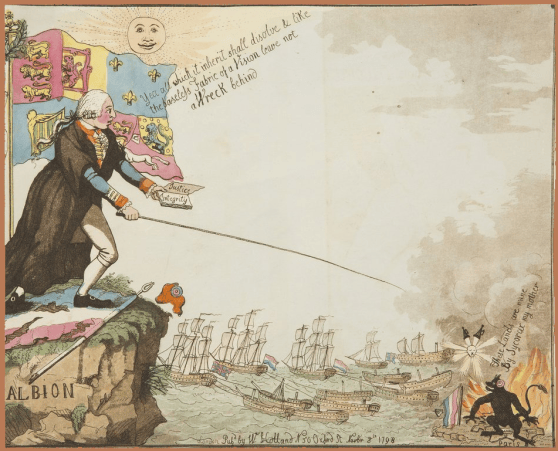
Sound familiar?
It is quite easily argued that if Prospero were a country, he would, without a doubt, be America. Just as Prospero is the self-proclaimed ruler of the island, America is the self-proclaimed ruler of the world. The country has retained an obsession with “saving” natives of other nations and “creating order” through military presence or ideological imperialism. The US creates technology and weapons which serve the same purpose as Prospero’s magic/gadgets: to be used as tools to advance conquest and strike fear in the hearts of enemies. Such a comparison is made clearer upon analyzing a few real-life examples, particularly in Okinawa and the Middle East.
After WWII, Japan was prohibited from engaging in offensive operations, so the US military expanded its presence to the island of Okinawa to serve as the Japanese offense and to monitor Southeast Asia. The American presence in this area has persisted for  decades, and in many ways, it is doing much more harm than good to the original inhabitants of the island. For one, the military projects in that area threaten the most productive ecosystem in the world, the coral reefs, which are responsible for the immense species diversity ranging from sea turtles to mammalian dugongs in the area. Furthermore, thousands of crimes have been linked to the US presence; the American Service Committee states, “From 1972 to 2010, there were nearly 10,000 US Military-related crimes and accidents officially recorded, including 1,545 reported US military accidents. ” Though some may argue that the American presence is essential for Japanese protection, the reality is that Japan is completely capable of defending itself:
“Japan has been supplied with advanced military equipment from the U.S. In the coming year, it is slated to purchase new anti-missile destroyers, submarines [etc.]… The Japanese islands are also well protected by a missile defense system… Japan’s SDF has the strongest navy and air force in Asia[, and even though Japan is]… restricted by Article 9 of the Constitution, which forever renounces war as a sovereign right of the nation… [many countries still] don’t want to mess with them [due to their advanced military].“
— Gus Lubin, Business Insider 2014
Like Prospero, America has felt the need to protect and safeguard an island that is well-off enough to take care of itself. In addition, just as the magician negatively affected the livelihood of the island’s inhabitants, America has harmed the native peoples and animals. It is no mystery why Okinawans are constantly protesting the US military presence.
A similar phenomenon is prevalent in the Middle East. In an effort to fight ISIL, the US has been sending an arsenal of ground troops, airstrikes, and drones to bring about “peace” in the region. Although America feels it is protecting the world, they refuse to acknowledge that they are actually killing far more innocent lives, and quite possibly increasing the terrorist threat in the process. An investigation by the New York Times revealed that, “… contrary to the claims of the Pentagon, as many as one-in-five coalition air strikes on Isis targets in Iraq in 2014, resulted in civilians deaths. That figure was 31 times higher than what the US has acknowledged.” While hundreds of people are dying from the American military involvement, the US justifies their actions by claiming they are fighting the global threat of terrorism; yet, statistics show that they may be perpetuating the problem. The Washington Post explains that increased American military presence in the Middle Eastern region empirically leads to a 24% increase in anti-American terrorism. Even former Secretary of Defense, Donald Rumsfeld, felt compelled to ask in 2004, “Are we creating more terrorists than we’re killing?”

To avoid such catastrophic impacts, many political experts find that it would be more sensible for US troops to train and advise Iraqi troops battling ISIL, who have greater knowledge regarding the region. Such troops would be more willing to fight for the security of their country but also take into account the safety of civilian lives.
Once again, we see that America is Prospero, obsessed with control and declaring its presence is protective when the truth of the matter is that he is responsible for the suffering of others— except in this case, the suffering is of far greater magnitude.
The key point here is that both Prospero and the US live in a state of delusion: they derive their power from picturing others as incompetent and in need of saving, believing that only they can bring order. The reality, though, is that both figures are the greatest sources of disorder in their respective worlds because of their constant unwanted interference. Political philosophy would benefit from reading Césaire and understanding this unfortunate comparison, as it sheds light on new ways to acknowledge and help the oppressed. Unlike A Tempest, however, the world is not full of nonhuman Calibans and Ariels. It is important for the dominating power to become self aware and break free of the intoxicating and illusory process that it is trapped in order to realize the competency, intelligence, and sovereignty of other human beings around the world. On the end of the spectrum, it is equally important that the rest of the world stops handing power over to America just as Ariel and Caliban did with Prospero. The United Nations was supposedly created to avoid the domination of one world power, and yet, the US somehow managed to control that organization, a fact met with little resistance from other world superpowers. Thus, the battle against iron-fisted US conquest involves two critical steps: self-actualization on the part of America, and active resistance on the part of the rest of the world. After that, the cycle of oppression will come to a permanent halt.
Detail of Prospero on the Enchanted Island, 1798 by Unknown
Rouveroy, Maarten van. Greenpeace Protesters against the US Military Base. Okinawa.
AFSC OKINAWA FACT SHEET (n.d.): n. pag. American Friends Service Committee. Dec. 2010. Web.
Lubin, Jeremy Bender and Gus. “Why Japan’s Smaller Military Could Hold Its Own Against China.” Business Insider. Business Insider, Inc, 05 May 2014. Web. 02 Apr. 2016.
Buncombe New York @AndrewBuncombe, Andrew. “US Has No Idea How Many Innocent People It’s Killing in the Middle East.” The Independent, Independent Digital News and Media, 5 Dec. 2017.
Pape, Robert. “Why U.S. military involvement will hurt Iraq and increase suicide terrorism.” The Washington Post, June 19 2014.
Nath, Paresh. “ISIS & Human Shield.” The Khaleej Times, UAE, 2016.
Crowley, Michael. “Iran Might Attack American Troops in Iraq, U.S. Officials Fear.” POLITICO. Politico, 25 Mar. 2015. Web. 09 May 2015.
 alizahumcoreblog.video.blog