When it comes to news involving Muslims, the top headlines are overwhelmingly about extremism.
“Terrorist attacks committed by Muslim extremists receive 357% more US press coverage than those committed by non-Muslims, according to new research from the University of Alabama… Terrorist attacks committed by non-Muslims (or where the religion was unknown) received an average of 15 headlines, while those committed by Muslim extremists received 105 headlines.”
— Mona Chalabi, The Guardian 2018
It seems that while stories regarding radical Islamists flood the news, the pressing humanitarian crises occurring in several Muslim countries are left unknown. In Syria, Palestine, Sudan, Yemen, and other countries, people are facing the threat of violence or death each day.
Syria
The civil war in Syria has been continuing for several years, and press attention on this major conflict has only been dwindling. According to a U.N. report from 2015, 210,000 people have been killed and another 840,000 have been injured as a result of the Syrian civil war. Life expectancy at birth has dropped by 27 percent,” the report said. 80 percent of Syrian citizens in 2014 lived in poverty and 30 percent cannot meet basic food needs for their households.
3 million civilians— 1 million of which are children— were moved to Idlib because they would not submit to the Assad regime. Earlier this year, these civilians were brutally killed, and the world has responded with “deafening silence”.

Back in 2015, the photo of 2-year-old Aylan Kurdi’s body washed up on a beach in Syria had grasped the world’s attention enough to have people aware of the conflict. As the years have gone by, though, the US still refuses to accept more refugees or significantly intervene in the conflict. According to Business Insider, “The Trump administration has admitted the lowest number of refugees the US has accepted in decades.” While this is a fact that anti-immigration proponents believe is for the best, America’s lack of action, as well the media’s lack of news, is resulting in the loss of hundreds of thousands of lives.
Yemen
The famine in Yemen is one of the greatest humanitarian crises in decades. After Saudi Arabia had intervened in the conflict, approximately 50,000 people have died; even more shocking is the amount of people on the brink of starvation: roughly 12 million.
“The most common war casualty in Yemen is not a soldier with a bullet but a child who is starving.”
— Nichlas Kristof, The New York Times 2018
While America and Saudi Arabia believe that the Yemen War is a way to keep tabs on Iran, that has not been the case. Intense suffering is blatantly evident, and yet “the US military continues to provide maintenance, tech support, and training to the Royal Saudi Air Force, as investigative journalist Ken Klippenstein has reported”. American media has failed to track this major crisis, and thus much of America is unaware of the ongoing atrocities.
Palestine
Although people are aware of the conflict in Palestine, many do not understand the magnitude of the chaos or why Israeli actions should not be supported. Since 1967, Israel has been establishing settlements in Palestine that have had no legal validity, according to the UN Security Council. Israeli actions have thus not only led to thousands of Palestinian deaths, but also have constituted “a flagrant violation under international law”. Because of US support, though, Israel has faced no consequences for centuries of breaking the law.
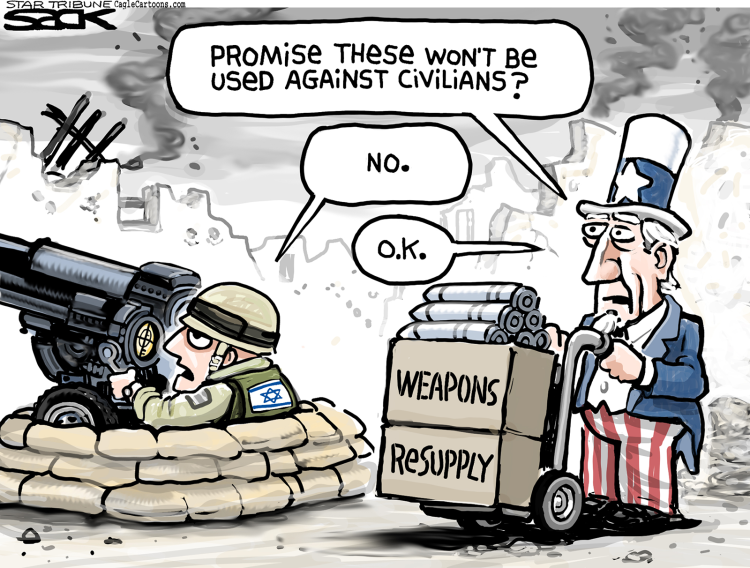
“During Fiscal Year 2018, the U.S. is providing Israel with at least $10.5 million per day in military aid and $0 in military aid to the Palestinians.” Such support has only catalyzed the conflict, as 1,242 Israelis and at least 9,510 Palestinians have been killed since September 29, 2000. While 0 Israeli homes have been destroyed by Palestinians throughout the conflict, at least 48,488 Palestinian homes have been demolished by Israel since 1967.
Under the Trump presidency, Israel has felt more entitled to continue breaking international law. Palestine has been shrinking every year, both in population and in territory due to US-backed Israeli actions. As America silently perpetuate the issue, the media remains quiet,
Sudan
As the political conflict in Sudan escalates, at least 124 people/protesters have been killed by security forces, with 700 injured and scores of rape cases being reported. Bodies have been thrown into the Nile and the government continues to oppress its citizens. Despite how current this catastrophe is, news outlets have failed to report what has been going on in the country. Surprisingly enough, it has been social media that has educated Americans about the conflict.
American citizens have seemingly become aware of the media bias against Islamic countries especially in this scenario, and thus they have taken it upon themselves to educate themselves and others about Sudan. In fact, many have taken part in the “going blue for Sudan” movement, changing their profile pictures to blue to stand in solidarity with Hashim Mattar, a victim of the Sudanese government, as well as the rest of the Sudanese citizens.
The US government and media have shown time again that what they choose to fund or report respectively is extremely biased and often incredibly unfair to the millions of lives suffering around the world. Much of it is political, as there is “no gain” for the US to assist in Syria, but it is important to maintain ties with Saudi Arabia and support the violence in Yemen. Regardless, America has taken on the role as the international police for decades now. This includes helping Muslim countries for reasons other than the economy. Our country needs to realize that its self-imposed responsibility is to intervene when there is injustice, not when there is simply an economic or political gain. Such a process begins with the US media; instead of excessively flooding news stories with Islamic extremism, it is time for Muslim countries in crisis to receive headlines. This way Americans can be educated about the real issues in the world, and push their government to act accordingly.
Chalabi, Mona. “Terror Attacks by Muslims Receive 357% More Press Attention, Study Finds.” The Guardian, Guardian News and Media, 20 July 2018, http://www.theguardian.com/us-news/2018/jul/20/muslim-terror-attacks-press-coverage-study.
“Editorial Cartoons.” Syrian Children – Mike Keefe Political Cartoon, 04/13/2017, http://www.intoon.com/cartoons.cfm/id/157978.
Gal, Shayanne. “The Trump Administration Has Admitted the Lowest Number of Refugees the US Has Accepted in Decades. Here’s What People Go through to Make It to the US.” Business Insider, Business Insider, 14 June 2019, http://www.businessinsider.com/refugee-data-us-numbers-under-trump-graphics-2018-6.
Gil, Natalie. “Rape, Massacre & Despair: Why The Crisis In Sudan Should Be A Wake Up Call.” What Is Happening In Sudan? Political Crisis, Explained, http://www.refinery29.com/en-us/2019/06/235332/sudan-massacre-crisis-news-whats-happening.
“Israel Palestine Conflict.” Cagle Post Israel Palestine Conflict News, http://www.cagle.com/news/israel-palestine-conflict/.
“Israel’s Settlements Have No Legal Validity, Constitute Flagrant Violation of International Law, Security Council Reaffirms | Meetings Coverage and Press Releases.” United Nations, United Nations, http://www.un.org/press/en/2016/sc12657.doc.htm.
Knew, If Americans. “What Every American Needs to Know about Israel/Palestine.” If Americans Knew, ifamericaknew.org/.
Kristof, Nicholas. “This Is What Our Yemen Policy Looks Like.” The New York Times, The New York Times, 13 Dec. 2018, http://www.nytimes.com/2018/12/12/opinion/yemen-children-famine-war.html.
Patrick, Anita. “Social Media Goes Blue for Sudan.” CNN, Cable News Network, 13 June 2019, http://www.cnn.com/2019/06/13/africa/sudan-social-media-campaign-intl/index.html.
“Refugees: Economic Boon or Burden?” U.S. News & World Report, U.S. News & World Report, http://www.usnews.com/news/blogs/data-mine/2015/09/15/would-syrian-refugees-be-an-economic-boon-or-burden.
Rogin, Josh. “Only Trump Can Save Syria’s Idlib, but Time Is Running Out.” The Washington Post, WP Company, 9 May 2019, http://www.washingtonpost.com/opinions/global-opinions/only-trump-can-save-syrias-idlib-but-time-is-running-out/2019/05/09/dd7cf19a-728e-11e9-9eb4-0828f5389013_story.html?noredirect=on&utm_term=.4f87433b346d.
Rohrlich, Justin. “Senate: No Support for Saudi War in Yemen. Pentagon: LOL.” Quartz, Quartz, 3 Jan. 2019, qz.com/1514582/us-supports-saudi-war-in-yemen-even-after-senate-votes-no/.
“Syrian Refugee Crisis: Facts, FAQs, and How to Help.” World Vision, 7 June 2019, http://www.worldvision.org/refugees-news-stories/syrian-refugee-crisis-facts.

