
“History repeats itself”. Today we will discuss this common pithy statement in terms of the behaviors of the 16th and 21st century superpowers, which, I argue, have been consistently exploitative over the course of many centuries. To do so, we shall analyze and compare two images involving the indigenous peoples of the Americas, one depicting the early 1500s Spanish-Incan interaction and the other from a more recent crisis, the construction of the Dakota Access Pipeline.

Figure 1: The Inka asks what the Spaniard eats. The Spaniard replies: “Gold.”1 From Felipe Guaman Poma de Ayala, The First New Chronicle and Good Government (or El primer nueva corónica y buen gobierno), c. 1615, p. 371 (image from The Royal Danish Library, Copenhagen)
The image above was drawn by Guaman Poma2, a Quechuan nobleman who chronicled much of the major events in the Incan empire in the 16th century. An iconographic analysis reveals that the man sitting to the left is adorned with a mascapaicha, the crown of the Sapa (ruling) Inca, as well as with royal cumbi cloth. Hence, this figure is the Sapa Inca, while the person to the right, given the time period, his company, large boots, and cape, is evidently a Spaniard. Looking carefully, we see that the Sapa Inca asks: “Cay coritacho micunqui?” (Is this the gold you eat?), to which the Spaniard responds, “Este oro comemos.” (This is the gold we eat). A stylistic analysis shows that during this conversation, the Sapa Inca has his eyebrow raised and his finger pointing to the gold in the dish, expressing his shock upon realizing that this strange Spaniard eats the metal before him. The Spaniard has his eyebrow scrunched and also points a finger to the gold, eyeing it concerningly while casually affirming that he does, indeed, eat it. The image that Poma has illustrated here strongly suggests that the Spanish are utterly ravenous for gold. They are obsessed with the commodity, so much so that the Incans gather that the gold is practically food to the Spanish, a concept which they find extremely odd and unsettling (and rightfully so).
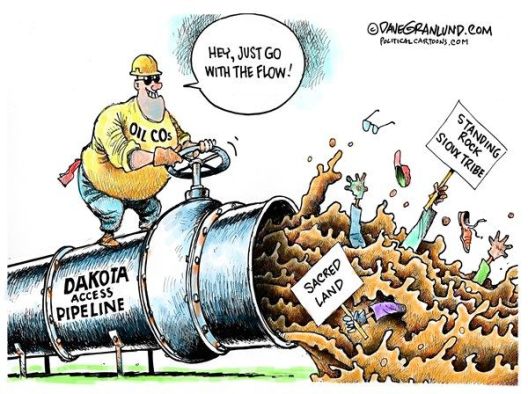
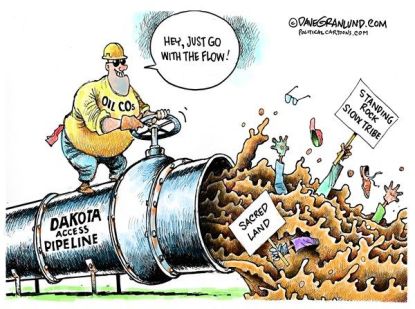
Figure 2: Dakota Access Pipeline3 Political cartoon by Dave Granlund, Nov. 2016
The second picture shown directly above was drawn by Dave Grunlund in 2016 during the height of the Dakota Access Pipeline (DAPL)4 crisis publicity. The pipeline is designed to transport crude oil from North Dakota to an oil terminal in Illinois. However, the native Standing Rock Sioux in the area were concerned that the area that the pipeline would stretch to could invade their ancient burial grounds and threaten their water supply (the Missouri River). The iconography of the related image effectively depicts this dilemma. One of the picket signs indicates the protest is in alliance with the Standing Rock Sioux, while the other suggests defending the sacred land. On top of the pipeline is a white man representing oil companies sucking up oil despite the presence of the protesters, drowning them in the process. By stylistically analyzing the cartoon, we find that the oil shown physically drowning the protesters alludes to the silencing of them as well. Furthermore, the white man’s comment, “Hey, just go with the flow!”, is a pun —as the oil is quite literally flowing and absorbing the natives into that current— yet it also reflects the infamous American policy of doing whatever they want and expecting all other parties to mindlessly cooperate. This illustration is critical in demonstrating that the United States has an intense obsession with oil, one that is so strong that they ignored crucial facts regarding the DAPL crisis. The U.S. Army Corps of Engineers claimed that the pipeline does not threaten the natives’ water supply or burial grounds, but the statistics they provided were heavily flawed:
During the remand process, the Corps withheld critical technical information from the Tribe, making it challenging for the Tribe to offer detailed technical comments on the Corps’ flawed analysis. The Tribe sought to highlight the risk of an oil spill in Lake Oahe, which is part of the Tribe’s reservation. Yet the Corps ignored an extensive body of technical material prepared by the Tribe showing that the risks of an oil spill from DAPL — which is managed by companies with the worst safety and compliance record in the nation — are much higher than disclosed. Lake Oahe is central to the Tribe’s culture and economy, and the danger to the Tribe is far greater than previously documented.
— Earth Justice Organization5
Comparing the two images, we see that both reflect a seemingly timeless imperialist trend: global superpowers, whether it’s the Spanish in the 16th century or the Americans in the 21st century, are alike in their severe obsession with commodities. In the past, it was gold and silver; now it’s oil. Natives once found this obsession peculiar, but today,
they rightly find it downright outrageous because it infringes on their way of life. It seems that these superpowers have always been economically driven and have little regard for who they harm to satisfy their hunger.
This conclusion has several implications. As much as we like to think we are progressing, we are undeniably stuck in the same consequential practices as five hundred years ago. We are still allowing the people who have (arguably) been hurt more than any other race in American history to once again be in fear for their land. Even the protesters, who are supposed to be protected by the Bill of Rights, were harmed by the American drive for oil. Unfortunately, the problem largely comes from we, the civilians. Two years ago, the DAPL’s construction was halted by the Obama administration in response to nation-wide protests supporting the Standing Rock Sioux’s pressing worries. At this point, the pipeline crisis had an immense amount of publicity which significantly decreased when the issue was put on pause. However, the national “hype” didn’t seem to return when the Trump administration overturned Obama’s suspension of the DAPL project and proceeded to finish construction of the pipeline— which has had several leaks over the past few months6.
Whether it’s the DAPL or a walkout for gun violence, we Americans join in on the hype, the fervor of topical issues until they aren’t “trendy” anymore. Some may argue that we stop fighting for what we believe in because the politicians don’t listen, but the fact of the matter is that politicians are aware of this phenomenon— they know we will eventually go silent, so they simply wait out a few hot minutes of civilian protest. Until we are able to fight consistently alongside the oppressed rather than when it’s popular can we overcome exploitative imperialist motives that have tormented too many since the 16th century. This is certainly completely plausible— we are a democracy, after all.
1Poma, Guaman. The Inka Asks What the Spaniard Eats. The Spaniard Replies: “Gold.”. Copenhagen, 1615, https://www.khanacademy.org/humanities/art-americas/new-spain/viceroyalty-peru/a/guaman-poma-the-first-new-chronicle.
2Britannica, The Editors of Encyclopaedia. “Felipe Guáman Poma De Ayala.” Encyclopædia Britannica, Encyclopædia Britannica, Inc., 7 Oct. 2016, http://www.britannica.com/biography/Felipe-Guaman-Poma-de-Ayala.
3Granlund, Dave. “Dakota Access Pipeline.” Davegranlund.com, 2016.
4Worland, Justin. “Dakota Access Pipeline: What to Know About the Controversy.” Time, Time, 28 Oct. 2016, time.com/4548566/dakota-access-pipeline-standing-rock-sioux/.
5“Standing Rock Sioux Tribe Renews Legal Challenge Against DAPL.” Earthjustice, 2019 Earthjustice, 1 Nov. 2018, earthjustice.org/news/press/2018/standing-rock-sioux-tribe-renews-legal-challenge-against-dapl.
6Brown, Alleen. “Five Spills, Six Months in Operation: Dakota Access Track Record Highlights Unavoidable Reality – Pipelines Leak.” The Intercept, The Intercept, 9 Jan. 2018, theintercept.com/2018/01/09/dakota-access-pipeline-leak-energy-transfer-partners/.
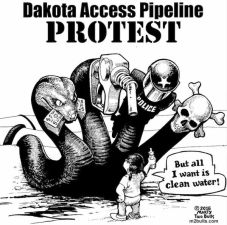
“But All I Want Is Clean Water!” Marty Two Bulls, 2016.
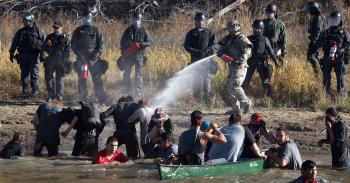
“Journalist Shot with Rubber Bullets during N.D. Pipeline Protests.” CBS News, CBS Interactive, 4 Nov. 2016, http://www.cbsnews.com/news/erin-schrode-journalist-shot-with-rubber-bullets-during-dakota-access-pipeline-protests/.

