Society tends to agree on certain universal ideas of which actions or ideas are considered good and which are considered bad. We have thus created a hierarchy in which a good person— an honest, kind, and generous one— dominates in morality over a bad one— who, for instance, lies and steals. Yet, social arguments emerge when more complicated situations are introduced, resulting in “gray” areas: is it okay to lie if it avoids someone pain? Can you steal food if your family is starving? The differing answers to these questions lead every human being to develop their own perceptions about morality. In doing so, we order and reorder these perceptions over time so that we create our own personal and dynamic hierarchies of the good and “less” good. This phenomenon inspires the two key questions that this blog post will explore: first, if some ideas of right and wrong are universally accepted, do humans have an inherent moral compass? If so, how exactly do we deviate from that baseline and form our hierarchies?
The question of whether humans are born with a sense of morality is often responded to with the consensus that we aren’t; we are brought into life with a “blank slate” and we owe our morals to the social institutions we were raised in. In other words, we are born without knowing what good and bad is. Many scientists, though, argue against this theory. They believe that a moral compass is inherent in humans, a fact proven by both animals genetically similar to us and babies. Primatologists such as Frans de Waal have shown that our closest animal relatives, from chimps to bonobos, have a sense of morality¹. One particularly notable experiment² by Professor Markowitz of San Francisco State University suggested the existence of moral virtues such as empathy in monkeys:
“In one of his [Markowitz’s] studies, individual Diana monkeys were trained to insert a token into a slot to obtain food. The oldest female in the group failed to learn how to do this. Her mate watched her unsuccessful attempts, and on three occasions he approached her, picked up the tokens she had dropped, inserted them into the machine, and then allowed her to have the food. The male apparently evaluated the situation and seemed to understand that she wanted food but could not get it on her own. He could have eaten the food, but he didn’t. There was no evidence that the male’s behavior was self-serving.”
— Professor Mark Bekoff, University of Colorado
Analyzing Professor Markowitz’s research, Professor Bekoff argues that since there was no benefit for the male monkey upon helping the female, the male monkey’s actions must have been driven by some moral compass that allows him to feel empathetic and act virtuously. This is one of many experiments regarding primates that imply the same conclusion: morality is hard-wired into our DNA.
Of course, the best way to study the origins of morality in humans would be to study young humans themselves. Experiments with babies further corroborate the animal research, as such studies find that babies do indeed have an innate moral sense. Yale psychologist and researcher Paul Bloom conducts many baby studies in the “Baby Lab” at Yale University³, one of which involved puppet experiments with young children (you can watch the video of the experiment here, from 1:25 to 2:18).
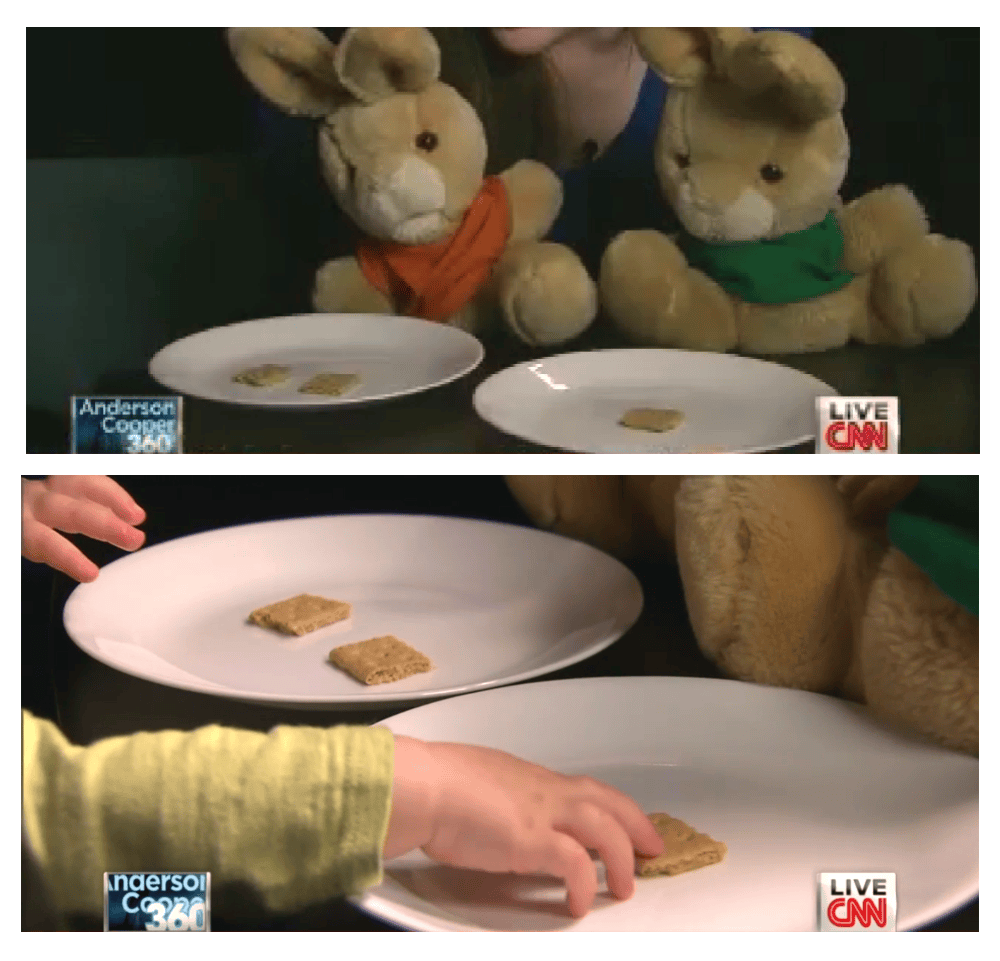
Figure 1: Baby Lab Experiment³ Lucy chose to take a smaller amount of crackers from the good green-shirted bunny over the larger amount from the bad orange-shirted bunny.
Notice the “baby version of a sacrifice”; most of the children chose to take the crackers from the “good” bunny (green shirt) even though it had less to offer than the “bad” bunny (orange shirt). In another experiment, 6-10 month year olds watched a puppet push a ball up a hill while a second puppet hindered the first puppet from doing so and a third helped the first push the ball. When given the choice, the babies choice to play with the helping puppet (the good one) over the hindering puppet (the bad one). Even in children as young as 3 months old, the researchers found that 87% favored the good puppet, which was suggested by their eye movement (babies eyes’ are drawn towards things they like). This study showed that not only do babies have a sense of morality, but they also have a predisposition to goodness.
It is reasonable to conclude that humans are born with a sort of moral compass and therefore tend to agree on what is considered bad and good behavior. So how does the hierarchy develop? The obvious answer is our social institutions and life experiences; however, how specifically these things influence the hierarchy is unknown. We will thus attempt to shed light on the process in which such experiences and institutions account for the ordering and reordering of the hierarchy of our morals.
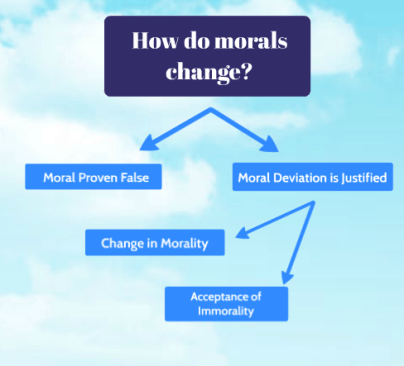
Figure 2: A Theory on Moral Changes Many people do not retain the same values as they did years ago. This figure attempts to dissect the causes of such changes.
The flowchart above summarizes the development of the moral hierarchy. People begin by building an ethical code based off their culture or environment in the early years of life, which is adjusted after either a) a certain moral is proven false or b) the deviation from said moral is continuously justified.
In the first scenario, a moral is proven false when a person is exposed to new information that challenges their pre-established moral. Let’s take the example of smoking:
- Original moral: Smoking is wrong. It damages your health and you shouldn’t do it.
- New moral, after trying smoking: Smoking is good. It makes me feel relaxed.
Here, the experience of smoking changed this person’s original moral because of the introduction of the new information regarding sensation, which was enough to completely flip the value. Smoking moves up in the moral hierarchy, becoming good.
In a second, more common situation, a person who values their ethical code more would be attached to the original moral and would attempt to justify any deviation from it. In this case, the person would try to convince themselves and others that their actions aren’t truly deviating from their values often by dragging other factors into the situation:
- Original moral: Smoking is wrong. It damages your health and you shouldn’t do it.
- Justification: I only smoked this one time because I was having a rough day; I don’t normally do it.
The person in this scenario used the quality of their day to make it seem as if they didn’t really do anything wrong. They still believe smoking is wrong, but cannot except that they committed a wrong act according to their code of ethics. Smoking remains low on the moral hierarchy.
It is the continuation of this justification (I smoked because my co-workers were, etc.) that eventually leads to one of two effects: a change in morality or an acceptance of immorality. When a person changes their moral code, they believe something pre-established to be morally wrong to be morally right, often garnering support from society.
- Original moral: Smoking is wrong. It damages your health and you shouldn’t do it.
- New moral, after continuously smoking: Smoking is good. It doesn’t really damage your health; I have lots of friends who smoke and are completely fine.
This person thus entirely denies the reasoning and conclusion behind the original moral, altering their values. Smoking moves up on the moral hierarchy.
Continuous justification may also lead to an acceptance of the immorality of an action. The person would acknowledge that their choice is immoral, but continue to proceed with it regardless by reducing how much value they place on that action.
- Original moral: Smoking is wrong. It damages your health and you shouldn’t do it.
- New mindset: I know smoking is wrong, but I just don’t care enough to stop.
The moral here remains the same, but it is the person’s mindset that changes. Smoking remains low on the hierarchy, a fact that this person has accepted.
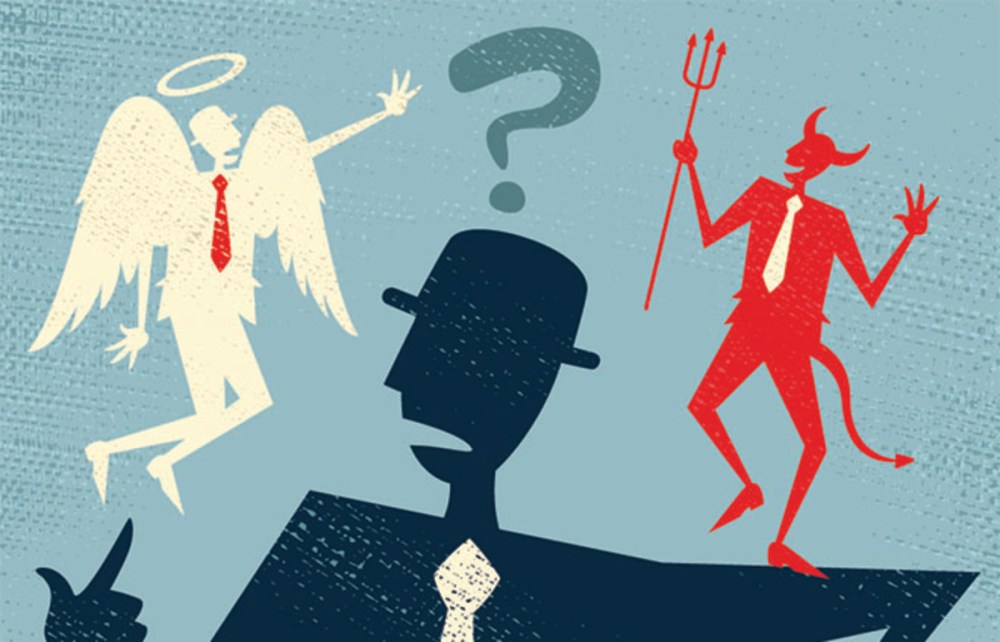
Figure 3: A Moral Dilemma⁴
Though we are all quite possibly innately moral, our sense of what that means changes in our lives. Our cultures and experiences allow for these changes, and thus explain why, for instance, Homer thought virtue lied in glory while Virgil believed it lied in Stoic ideals. Perhaps Virgil believed a virtuous person strove for glory when he was a child but changed this view upon realizing the Roman Empire’s emphasis on fighting for the greater good. Maybe Homer never changed his perceptions because he didn’t learn about Stoicism. Truly, inferring which of the aforementioned situations could have occurred to account for the changes in one’s moral hierarchy results in some fascinating theories.
¹Smith, Emily Esfahani. “As Babies, We Knew Morality.” The Atlantic, Atlantic Media Company, 18 Nov. 2013, http://www.theatlantic.com/health/archive/2013/11/as-babies-we-knew-morality/281567/.
²Bekoff, Marc, and Jessica Pierce. “The Moral Lives of Animals.” Wild Justice, University of Chicago Press, press.uchicago.edu/Misc/Chicago/041612.html.
³Chun, Susan. “Are We Born with a Moral Core? The Baby Lab Says ‘Yes’.” CNN, Cable News Network, 15 Feb. 2014, http://www.cnn.com/2014/02/12/us/baby-lab-morals-ac360/index.html.
⁴McLeman, Jorgen. “Abstract Businessman Has a Moral Dilemma.” 123RF, http://www.123rf.com/photo_23081750_abstract-businessman-has-a-moral-dilemma.html.

