Last blog post we discussed the lifespan of an empire. Today’s topic is centered around what happens after an empire has established itself as a dominating force and has conquered other areas. Rather than discussing these effects in terms of the empire in relation to other empires as explored before, we will consider the primary and secondary effects of conquest on the peoples of the empire. Specifically, the trend being emphasized is a shift from heterogeneity to homogeneity in regards to culture.
Before proceeding, it’s crucial that the distinction between a homogeneous population and a homogeneous culture is understood. A homogeneous set of people refers to individuals with few distinctive characteristics, like those of the same race, whereas a heterogeneous population includes people who do have different characteristics, like those of different races¹. In contrast, a homogeneous culture can include a heterogeneous population of different races that share a common culture. For example, America has a homogeneous culture characterized by things like sports, but the country itself is composed of a heterogeneous population of all kinds of races. For our purposes, we will be exploring the push towards a homogeneous culture after conquest.
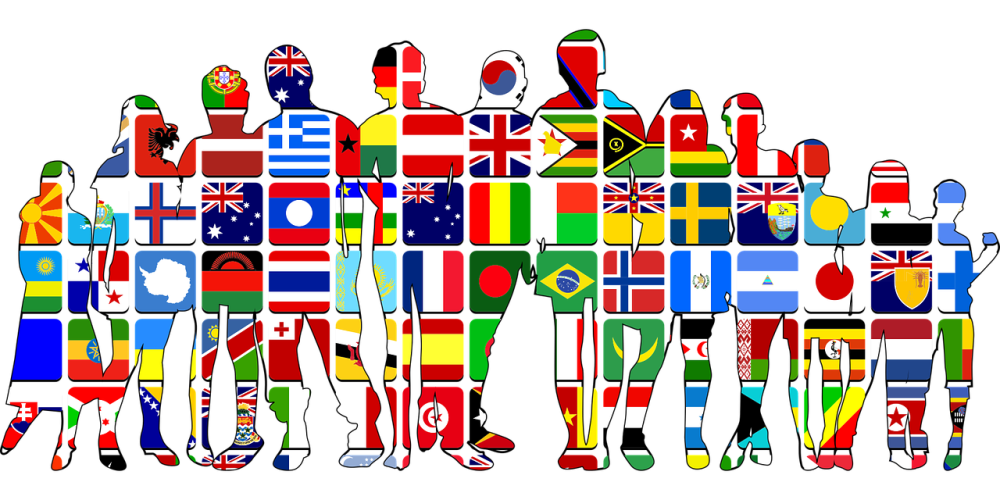
Figure 1: Depiction of a Heterogeneous Population² Different types of people can form a single population, and perhaps even a single culture.
The initial result of an empire conquering a set of peoples is a heterogeneous culture characterized by a power imbalance and hence negative relations between the conqueror and the conquered, meaning that the cultures and attitudes of the conqueror are distinct from those of the conquered. This makes sense because the idea of conquering inherently establishes a power imbalance in which one is superior and another is inferior. Thus, the implied negative relations between the two result in a heterogeneous culture that persists until social progress causes a decline in the power imbalance. This dilemma is often the primary effect of conquest.
Social progress in the forms of change to reduce racism, sexism, and other inherently power imbalanced phenomenons work to catalyze the shift to the secondary effect is a homogeneous culture. However, the difficulty and length of this process varies from situation to situation. In other words, the aforementioned primary effects can either be shorter or longer depending on which conqueror-conquered relationship is being discussed. For instance, when the Romans expanded their empire, the primary effect was initial backlash and tension. However, this often only lasted for a few decades until the Romans and the conquered formed a homogeneous culture known for its thermae (public baths), architecture, aqueducts, and other enjoyable aspects; this process became known as Romanization³, and it explains the development of the Pax Romana⁴ (the idea of Roman peace after conquering). It is the secondary effect of conquest. This type of integration does not occur as quickly as it did in the Roman empire in many cases, often due to the prevalence of racial and social barriers. In these instances, the shift to a homogeneous culture has longer primary effects of the power imbalance. One notable example is with American society. Racism was a significant aspect of American society during the birth of the country, as is fueled the specialization of specific racism into certain demeaning roles, such as with slavery, that led to negative relations. Even after slavery was abolished, the racial barrier existed; thus, for hundreds of years America was stuck in the primary negative effects of a power imbalance that blocked the development of a homogeneous culture. This is much longer than the comparatively shorter primary effect that the Romans experienced, which usually only lasted a few decades. However, social progress allowed America to significantly reduce the various power imbalances that were prevalent hundreds of years ago and evolve towards the secondary effect that the Roman empire underwent. Racism and sexism have decreased⁶, and thus negative relations have lessened as well resulting in the integration of ideologies and the adoption of a homogeneous culture in America. This is why America is frequently referred to as a “melting pot“⁵ of cultures in which people from around the world have come to the country and formed a new homogeneous culture characterized by a love for football, fast food, and holidays such as Thanksgiving. Even formally exclusive religious aspects of life— such as the celebration of Christmas— that were brought to America have become cultural phenomenons celebrated by non-religious peoples. Clearly, there is a great time difference between the Roman empire and America in regards to adopting a homogeneous culture. This is explained by the willingness of the conqueror and conquered to engage in cultural assimilation; the areas Rome conquered were more willing to assimilate compared to blacks and whites in America. Barriers such as race can contribute to the lack of the inclination to assimilate, which was evident in the case of America. 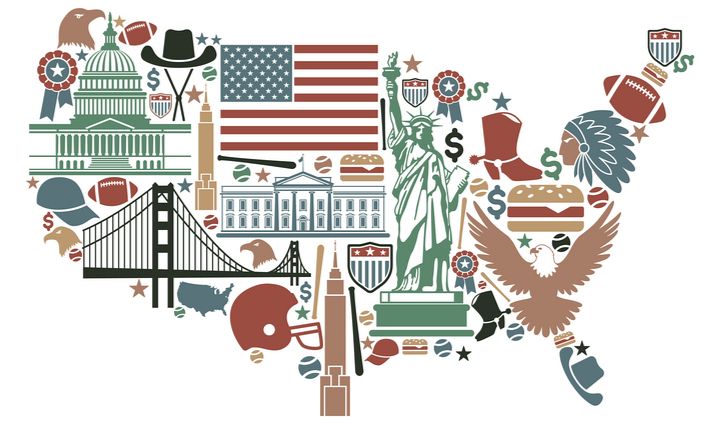
Figure 2: American Culture, World Atlas⁷ American culture is comprised of many aspects, shown by the prevalence of burgers, baseball, and modern architecture in the figure.
The existence of the primary and secondary effects of conquest are depicted by figures in history as well. Calgacus, a fictional character Roman author Tacitus’s Agricola⁸, was shown as someone who detested the Roman empire because of its harmful primary effects. He claimed that the expansion of the Roman empire caused violence and negative relations rather than peace. Contrarily, another Roman author, Virgil, implies in his Aeneid⁹ that the more long-term secondary effects of a homogeneous Roman culture outweighs the short-term primary costs. Depending on the length of the primary effect and strength of an ideological barrier, the validity of both arguments vary; if the primary effect is too long and problematic and a barrier (such as race) cannot be broken, one could argue that the secondary effect of a homogeneous culture is unattainable and therefore not worth the cost. This causes an eventual rejection of the conquering empire by the conquered. An example of this is when Britain attempted to expand its empire to India¹⁰; the problematic effects of the British viceroy’s policies created seemingly unbreakable barriers that caused the Indian citizens to eventually revolt and reject the British empire. Here lies the distinction between the Indians and the Americans in these situations: although Americans also had a great barrier, race, they were able to reduce its effects over a long period of time enough so that the secondary effect of a homogeneous American culture became feasible.
Although we previously created a distinction between a homogeneous culture and a homogeneous population, we can draw a parallel between the two as well. As the homogeneous culture secondary effect persists, the elimination of power imbalance has caused increased, closer interactions between different types of people. This explains the growth of the mixed, multiracial population in America shown in Figure 2. Thus, the homogeneous population of the nation is expanding along with its homogeneous culture.
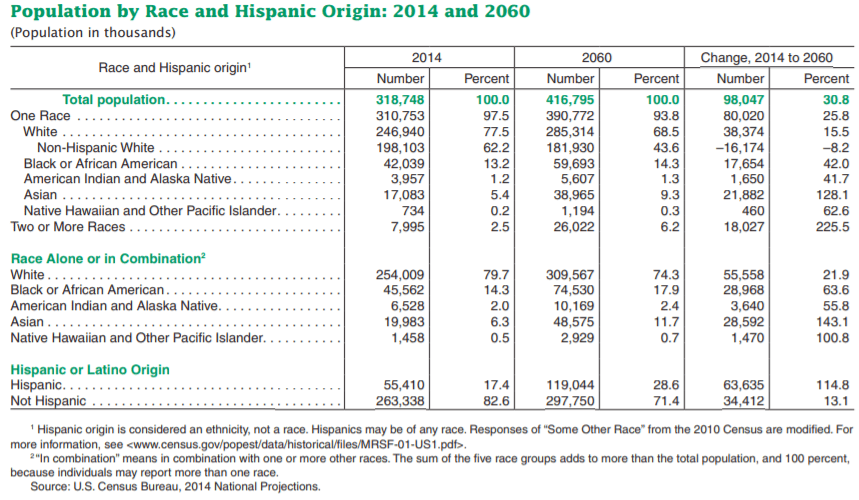
Figure 3: Population by Race Chart, US Census¹¹ Note the increase in the multiracial population from 2014 to the projections in 2060 (2.5% to 6.2%).
Looking in the context of the trends we have explored, America specifically has accomplished much in terms of social progress. We have uniquely established our own homogeneous culture while retaining a heterogeneous population (which is slowly becoming increasingly homogeneous as well). Considering the difficulty of breaking barriers that limit doing so, this is a particularly notable feat— one that we should continue to strive toward by being persistent in breaking the negative divisional barriers that exist in society, thus catalyzing the growth of the ideal secondary effect.
¹“Heterogeneity and Heterogeneous Data in Statistics.” Statistics How To, 14 Nov. 2017, http://www.statisticshowto.datasciencecentral.com/heterogeneity/.
²“The Benefits of Multiculturalism in the Workplace.” Wolfestone Translation, 2 May 2018, http://www.wolfestone.co.uk/blog/benefits-multiculturalism-workplace/.
³“The World of the Ancient Romans – Culture.” The Ancient World, Copyright 2008-2018 The Ancient World, http://www.theancientworld.net/civ/roman_empire_culture.html.
⁴“The Pax Romana.” Ushistory.org, Independence Hall Association, http://www.ushistory.org/civ/6c.asp.
⁵“Americas | ‘Melting Pot’ America.” BBC News, BBC, 12 May 2006, news.bbc.co.uk/2/hi/americas/4931534.stm.
⁶“Racist Behaviour Is Declining in America.” The Economist, The Economist Newspaper, 1 Sept. 2017, http://www.economist.com/democracy-in-america/2017/09/01/racist-behaviour-is-declining-in-america.
⁷Sawe, Benjamin Elisha. “What Is American Culture?” World Atlas, Worldatlas, 23 Aug. 2018, http://www.worldatlas.com/articles/what-is-american-culture.html.
⁸Tacitus, Cornelius. Agricola. Cambridge University Press, 2015.
⁹Maro, P. Vergilius. The Aeneid. The University of Chicago Press, 2017.
¹⁰McNamara, Robert. “How Colonial Rule Defined India in the 1800s.” Thoughtco., 30 June 2018, http://www.thoughtco.com/timeline-of-india-in-the-1800s-1774016.
¹¹Colby, Sandra L, and Jennifer M Ortman. Projections of the Size and Composition of the U.S. Population: 2014 to 2060. U.S. Census Bureau, Mar. 2015, census.gov/content/dam/Census/library/publications/2015/demo/p25-1143.pdf.

