In the previous blog post, we discussed the effects of a powerful empire and its ever-expansive nature. However, upon close evaluation of this phenomenon, many of us are prompted to consider: how do thoughts or corporations attain such authority over society in the first place? In other words, how does an empire come into being?
This question is the focal point for today’s blog post, which will center around the development of empire. We will begin by exploring the origins of empire and continue by tracing its growth into a dominant force. Additionally, the interactions of a developed empire with others shall also be illustrated, while following a few examples to view this development in a relatable scenario. It is also important to remember throughout this post that the described growth is based purely on logic derived from observations of empires in real life, meaning that the argument here is a general trend specifically with most empires of thought.
An empire begins as not an empire, but rather, as a thought or set of beliefs regarding a subjective view of what would make the world “better”. These thoughts stem from one or more people and are discussed until others begin to understand and agree with the beliefs. At this point, the main goal of projecting these beliefs is to be able to share a way of thinking and live in harmony, despite the fact that others don’t believe such a way of thinking would create harmony. We can see such a trend with, for instance, the empire of democracy. The core tenant of a democratic government is the notion that the citizens of a state should have a say in the election of political officials¹— this was the starting thought. This began as an idea in Athens² but it wasn’t adopted by others until the 18th century in which the Americans’ distaste of monarchy from personal experiences led to the desire of a government by the people. This view became common because of a mutual suffering, as well as the championship of such an ideal by respected officials such as Thomas Jefferson³. Thus, the central purpose of articulating this belief was to make life better for the Americans in the way they knew best; to create harmony amongst just themselves even though the rest of the world did not agree with their methods.
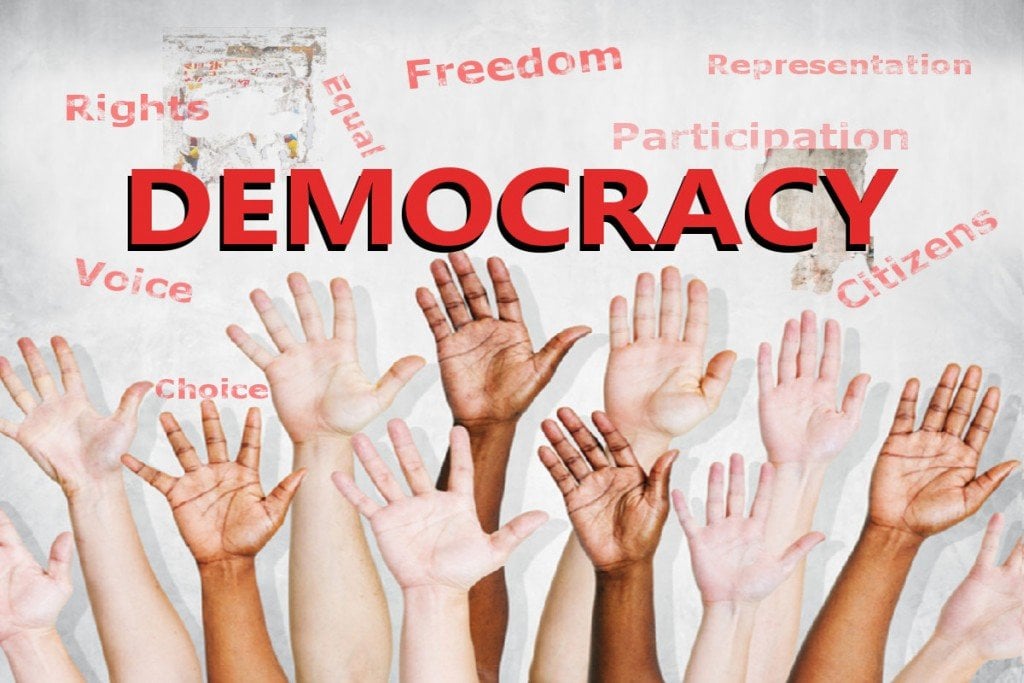
Figure 1: Democracy¹⁰ Modern Democracy represents the idea that anyone (regardless of race, class, gender, etc.) has a voice in government.
Eventually, a way of thinking grows exponentially, often due to strength in numbers, becoming a known, formidable force in society. Others begin to adopt the basic belief, and with continuous adoption comes increased unification of a set of believers. At some point, an idea becomes prominent and formidable enough to be known as an empire; it becomes dominant. Let’s continue with our democracy example in this context. By the 19th century, democracy had become the foundation of America, a potentially powerful nation. As the news of democracy spread throughout the world, its core idea resonated with many, inspiring the adoption of this system and the overthrow of other political systems. American democracy hence spurred the French Revolution and Haitian Revolution⁴, both of which abandoned a monarchy to form a democratic government. As proponents of democracy increased, the notion became a dominating force in the world, and thus, an empire.
Eventually, such an empire becomes aware of its power and dominance which often causes its proponents to become caught up in the growth. Rather than simply enjoying the way of life that a belief has created for them, members of an empire of thought start to desire the extension of their beliefs onto others, due to a belief that their followed idea is superior to others. Often times, the cost of doing so is to abandon values of the original thought to achieve the aforementioned growth. Once again, we see this phenomenon with democracy in America. Starting in the latter half of the 19th century, America became self-aware of its status as an influential democratic nation. It was then that democratic imperialism began, and the country began to “spread democracy” because it was thought of by Americans as the superior form of government. However, in doing so, they abandoned the original principle of democracy by essentially forcing it upon other nations, such as in Afghanistan⁵. However, it is important to note that this forcing simply creates the monarchical relationship (with one power exerting control over a group without the group’s input) that Americans despised in the first place, resulting in a paradox; yet, this democratic imperialism continues for the sake of the empire’s expansion.
“What really troubles me is that democracy is getting a bad name because it is identified with imposition and occupation. I’m for democracy, but imposing democracy is an oxymoron. People have to choose democracy, and it has to come up from below.”
— Madeleine Albright, former U.S. Secretary of State
After an empire becomes self-aware, the empire/thought remains dominant and continues its expansion. This occurs until it is challenged by another empire that is often equally as powerful, one that also underwent the same process of growth as its challenger. Once an empire is confronted by another, quarrel ensues. Democracy was (and still is) challenged by communist dictatorship in this way. In the 20th century, proponents of democracy in America began the practice of containment in Europe to stop the overall spread of the communist dictatorship⁶. Communist Russia began to fight democratic America for the imposition of each of their ideologies in areas such as Korea⁷. By now, we have seen the starting idea of democracy transform from the cherishing of an ideology to the forcing of that ideology on others. While back in the 17th century believers in democracy were content with practicing its tenants themselves, by the 20th century proponents began to exert their belief everywhere, leading to a constant state of dissatisfaction until the entire world believes in their beliefs. Empires aren’t about enjoying a belief anymore; rather, they’re about the obsessive pursuit of defeating the rivaling empires.
What this essentially implies is that fighting between ideological empires is constant and it only ends when one or both empires fall either temporarily or permanently. For example, the Russian dictatorship and American democracy continuously fought to impose their respective ideologies upon Czechoslovakia⁸. Russia pushed communism on the country, leading to a temporary fall of the democratic empire in that area. This empire rose once more, however, when the democratic Czech Republic was formed towards the latter half of the 20th century. It is evident that ideological empires like these continue in endless war for dominance.
This whole process continues within empires themselves as well. Different thoughts still arise in a common empire, leading to the formation of what I refer to as “sub-empires” that repeat the aforementioned process. We can see this trend once again with democracy; amidst the believers of this ideology are people who believe in different things regarding democracy, leading to the development of two big sub-empires— the Republicans and Democrats. Just like the relationship between democracy and the communist dictatorship, these two political parties have reached a stage of constant fighting in which the aim has regressed into simply beating the other party.

Figure 2: Democrats vs Republicans¹¹ There is a strong argument that politics has devolved into a constant battle of red vs blue.
This process has become a fundamental part of social development over time. But why does it all happen in the first place? Why are we so inclined to form and expand empires? One could answer this question by crediting the human tendency to form groups based on a shared quality or belief or set of qualities/beliefs, as described in Edward Said’s introduction to Orientalism⁹. Since every human being has different thoughts, there is an infinite amount of beliefs which is why we keep forming groups, and groups within groups, which explains the existence of both empires and sub-empires. The expansion of the empires is often related simply to intrinsic motivation for domination, and the dopamine effects associated with them.
Sharing an ideology does not necessarily mean that the advocates of the ideology are doomed to perpetually fight for control with other empires. Empires and sub-empires can form peacefully as long as they don’t exaggerate and forcefully exert their beliefs on other unconsenting people; that is, people with differing thoughts should simply let each other be. If conflict does happen to arise due to clashing (which often happens with sub-empires like Democrats and Republicans), the empires or sub-empires must work to form a cooperative solution instead of trying to solve the problem by exerting temporary authority of one empire over another (i.e. making Congress Democratic or Republican). Only then can peace exist in a society as diverse as the one in which we live.
¹“Definition of ‘Democracy’ – English Dictionary.” Cambridge Dictionary, dictionary.cambridge.org/us/dictionary/english/democracy.
²“History of Democracy.” History World, http://www.historyworld.net/wrldhis/PlainTextHistories.asp?historyid=ac42.
³“Jeffersonian Ideology.” Ushistory.org, Independence Hall Association, http://www.ushistory.org/us/20b.asp.
⁴“Waves of Revolution.” History Today, http://www.historytoday.com/david-motadel/waves-revolution.
⁵Sonja Grimm And & Wolfgang Merkel (2008) War and Democratization: Legality, Legitimacy and Effectiveness, Democratization, 15:3, 457-471, DOI: 10.1080/13510340801991072
⁶“Kennan and Containment, 1947.” U.S. Department of State, U.S. Department of State, history.state.gov/milestones/1945-1952/kennan.
⁷“Truman Orders U.S. Forces to Korea.” History.com, A&E Television Networks, http://www.history.com/this-day-in-history/truman-orders-u-s-forces-to-korea-2.
⁸Odlozilik, Otakar, and John F.N. Bradley. “Czechoslovak History.” Encyclopædia Britannica, Encyclopædia Britannica, Inc., 7 Mar. 2016, http://www.britannica.com/topic/Czechoslovak-history/Czechoslovakia-1918-92.
⁹Said, Edward W. Orientalism. London: Penguin, 2003. Print.
¹⁰“Democracy.” Kashmir Observer, kashmirobserver.net/2018/opinions/democracy-decaying-worldwide-america-isnt-immune-29300.
¹¹Garrison, Ben. “Voters Prison.” WordPress, Grrr Graphics, 2014.

